How itsme strengthened a critical authentication capability for more than 8 million users, without disruption.
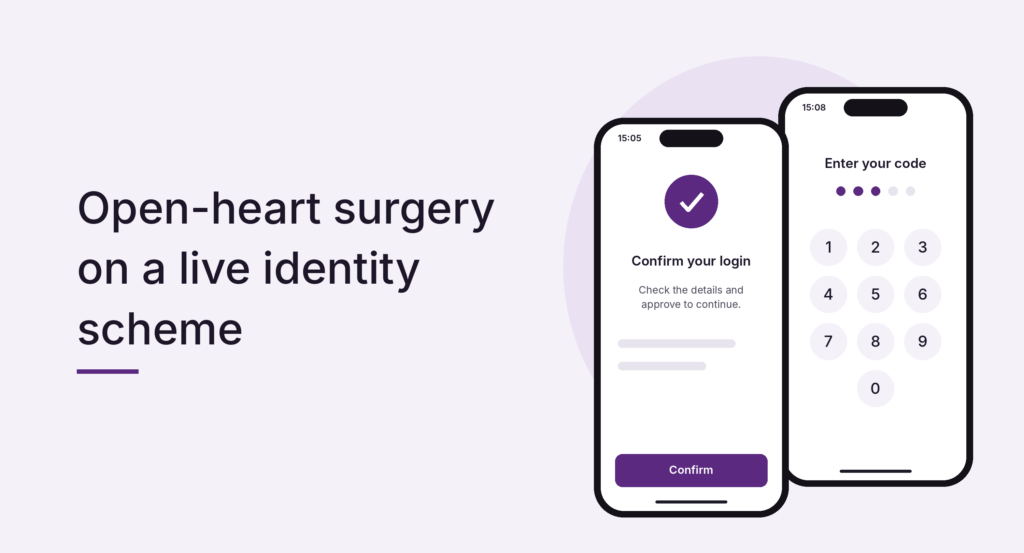
Every day, millions of people in Belgium and the Netherlands open itsme to log in, approve a payment or sign a contract. Each of those actions depends on cryptography that proves the right person, on the right device, agreed to it. In 2026, itsme replaced its existing user authentication mechanism with nextAuth – while the scheme stayed live. Thomas Vandemeulebroeke, CPO & CIO at itsme, compares the project to open-heart surgery.
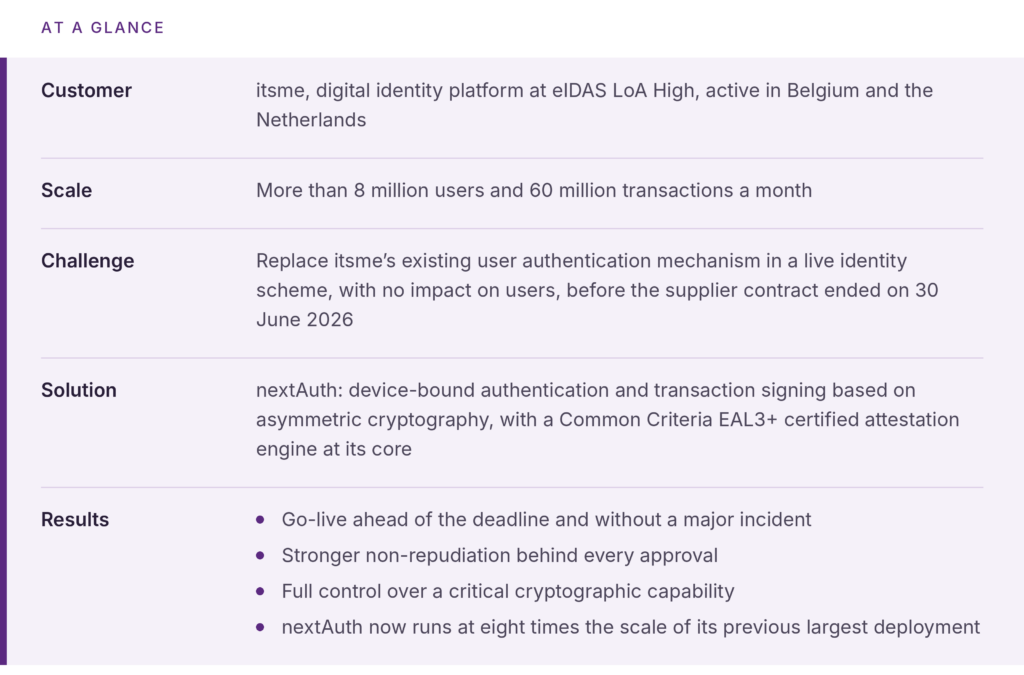
The challenge: a critical component on someone else’s roadmap
For the banks, insurers, telecom operators, energy suppliers and public services that rely on itsme, every login or approval carries two kinds of proof: proof of who someone is, and proof that they agreed.
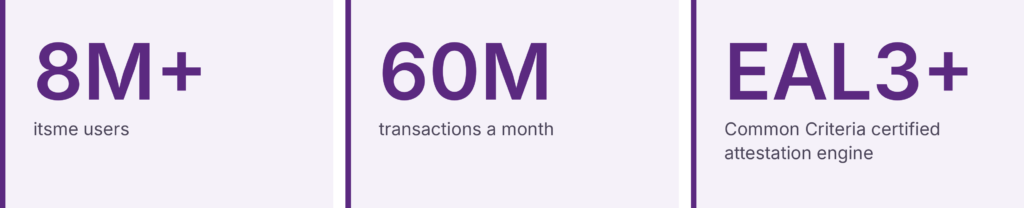
The latter rests on device-bound authentication and transaction signing. itsme has to show that the person approving an action still holds the device they registered. At more than 8 million users and 60 million transactions a month, there is very little room for error.
The existing component relied on a shared secret – the same principle behind the one-time passwords many banks still use. When both sides hold the same key, the proof behind an approval is weaker than it needs to be.
Another consideration was the roadmap. The supplier’s plans continued to focus on the one-time password and did not cover signature-based approvals or preparation for post-quantum cryptography, two areas itsme considered priorities. For a component that every login and approval depends on, itsme needed a roadmap aligned with its own direction.
As such, any replacement had to clear a high bar. It had to:
- run reliably for more than 8 million people;
- win approval from EU member states before it could carry authentication under eIDAS;
- go live without disrupting service, before the supplier contract ran out on 30 June 2026.
Why itsme chose nextAuth
nextAuth matched what itsme needed on three counts: stronger proof behind every approval, no extra friction for users, and full control over the engine.
1. Proof that only the user’s device can produce
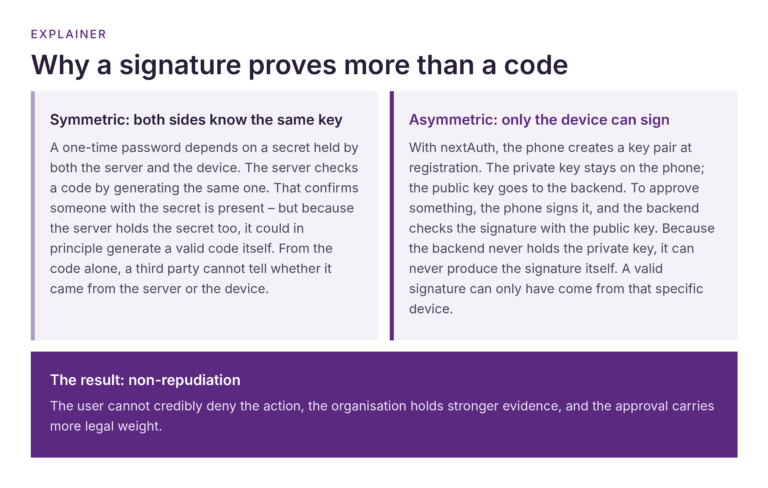
itsme’s value rests on proving that a person agreed. nextAuth was built on asymmetric cryptography from day one. That means the evidence behind an approval can only come from the user’s own device.
A one-time password relies on a shared secret,” explains Roel Peeters, co-founder of nextAuth. “The server and the device both know the same key. That only proves that a valid code exists. It does not prove who produced it. With nextAuth, only the user’s device can produce the proof.”
2. Stronger security without extra friction
For a platform that millions of people use every day, stronger proof could not cost users extra effort.
“Our goal has always been to combine strong security with a good experience, and to offer the market something we believe is genuinely better,” adds Jens Hermans, co-founder of nextAuth.
The migration: three phases, no big bang
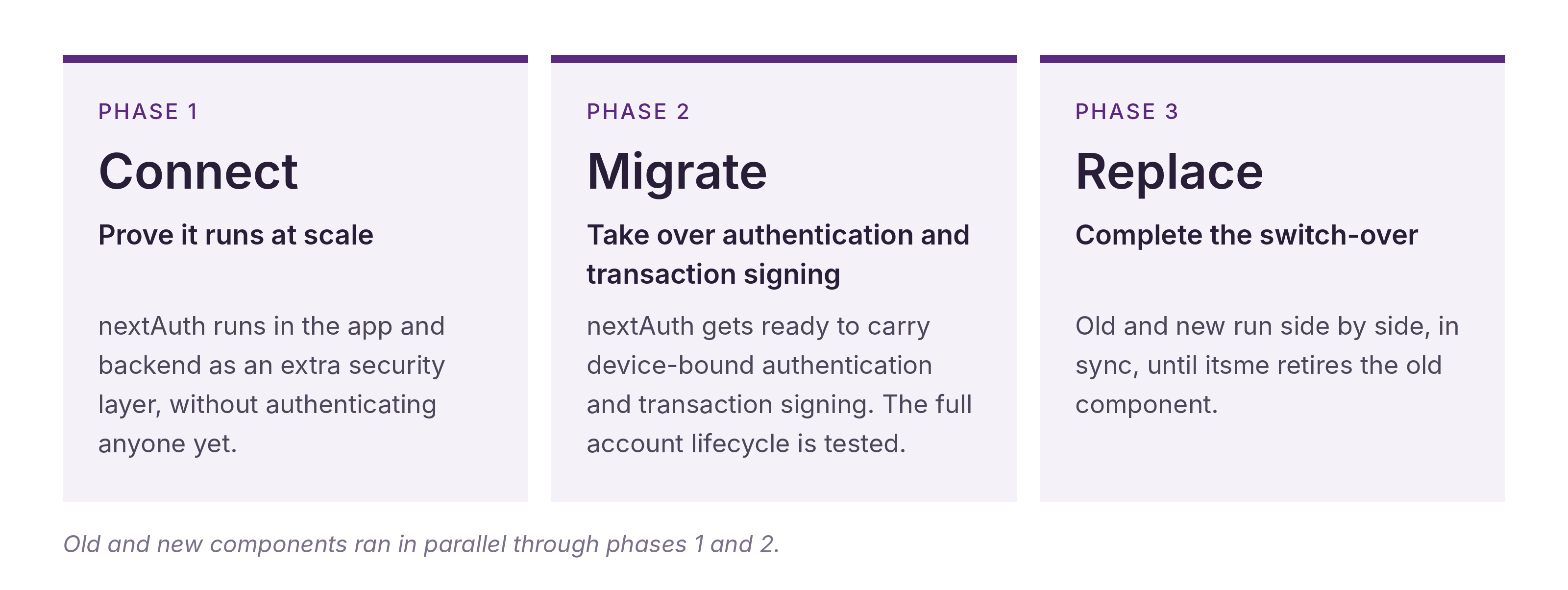
Putting nextAuth at the heart of a live national identity scheme did not happen in a single switch-over. “There were three core phases,” explains Gert Heiremans, Head of Technology & Security at itsme.
Phase 1 – Connect: prove it runs at scale
nextAuth went into the itsme app and backend, but did not yet authenticate anyone. “We ran it as an extra layer of encryption and device authentication on the traffic between device and servers, on top of the existing protection,” says Gert. “The goal was purely to prove the component worked reliably across 8 million users in production, and to strengthen the security of the API calls to the backend.”
Phase 2 – Migrate: take over authentication and transaction signing
Next, nextAuth had to be ready to take over device-bound authentication and transaction signing while itsme waited for EU approval. “itsme authentication rests on proving that the user still holds the device they registered,” Gert explains. “The cryptography behind that proof moved to nextAuth. Since a failure would hit real logins and real payments, the bar was very high.”
“Through phases one and two, old and new ran side by side,” says Pieter Maene, Authentication Technology Architect at itsme. “Every user had an old representation and a nextAuth representation, and the two had to stay in sync the whole time.”
This phase also validated the full account lifecycle: activation, blocking, unblocking, recovery, registering a new device and deactivation.
Phase 3 – Replace: the full switch-over
Finally, itsme completed the switch-over and retired the old component.
Go-live started in April 2026 and ran without a major incident. “The discipline that made that possible was monitoring,” says Pieter. “We kept a close eye on the number of blocked devices. When that number started to climb, we could always roll back a feature or switch it off. The team could do both at any point in the migration.”
Certification: third-party proof, not a sales claim
Before nextAuth could become part of itsme’s trust framework, it needed approval from EU member states. As part of that process, the team split nextAuth’s core into a separate second-factor attestation engine and put it through Common Criteria evaluation, the international standard for assessing the security of IT products.
In January 2026, the itsme Second Factor Attestation Engine was certified at Common Criteria EAL3 augmented (EAL3+), under the Netherlands’ NSCIB certification scheme.
“If a technology satisfies the requirements of a national-scale identity platform, it is very likely mature enough for a single organisation,” says Pieter. “A CISO or a security architect gets third-party validation instead of a sales claim.”
The results
- Delivered on time, without a major incident. Go-live began in April 2026, ahead of the 30 June contract deadline, while the scheme stayed live.
- Stronger evidence behind every approval. A valid signature can only be generated on the user’s device, so every approval carries non-repudiation.
- Proven at national scale. nextAuth now runs at eight times the scale of its previous largest deployment.
- A private channel to users. The move also gave itsme a private channel to communicate securely with its users.
Five lessons for your own migration
For security and IT teams planning to replace a critical authentication component, itsme’s approach doubles as a practical playbook.
- Prove scale before you depend on it. Run the new component in production in a non-critical role first. itsme used nextAuth to secure communication between app and server before it authenticated anyone.
- Run old and new side by side. Keeping both representations in sync for every user meant itsme could fall back at any time.
- Watch one leading indicator – and keep a kill switch. itsme tracked blocked devices and could roll back or switch off any feature at any point.
- Test the whole lifecycle, not just the login. Activation, blocking, unblocking, recovery, new devices and deactivation all have to work.
- Design for certification. Splitting out a certifiable core made independent evaluation achievable.